
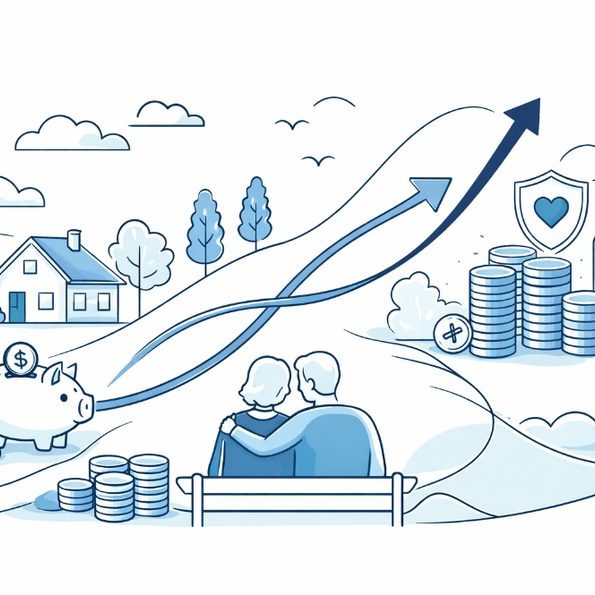
Inflation is quiet. It does not announce itself the way a market crash does. It simply chips away, year after year, at what a dollar will buy — and for retirees it is a bigger problem than for anyone else. While you are working, your income tends to grow and keep pace with rising prices. In retirement, your income is largely fixed: savings, pensions, and Social Security, none of which automatically keeps up with your real expenses.
Understanding how inflation affects retirement savings is one of the most important parts of retirement income planning. This article walks through how the erosion happens, and what you can actually do about it.
Why Inflation Hits Retirees Harder
Inflation compounds quietly, but the math adds up. A 3 percent annual inflation rate can cut purchasing power nearly in half over 25 years. For someone spending two or three decades in retirement, that shift can change a comfortable plan into a constrained one.
Retirees also tend to spend more of their budget in the categories that rise fastest — healthcare, housing, and utilities. Their expenses are not just rising; they are rising faster in the areas that matter most.
The Fixed Income Problem
Many retirees lean on fixed income sources like bonds, pensions, and annuities. These tools provide stability, but their real value erodes over time because the dollar payments do not adjust for inflation. Social Security provides cost-of-living adjustments, but those increases often do not fully match the actual expenses retirees face, especially for healthcare.
When fixed income forms the foundation of a plan, inflation gradually pushes more of the spending burden onto personal savings. That pressure is exactly why a balanced strategy usually matters more than any single income tool.
Sequence of Returns and the Near-Retirement Window
Near-retirees face a uniquely difficult period. There is less time to recover from market downturns, and many begin shifting portfolios toward lower-volatility assets just as inflation risk rises. If a market decline coincides with early retirement, withdrawals from a shrunken portfolio can permanently reduce how long the money lasts — a double squeeze that is central to retirement timing decisions.
Planning through this window is about coordination, not just investment choice. Decisions about when to retire, how much to draw, and how assets are allocated all interact with inflation and with market conditions around your start date.
What a Realistic Investment Strategy Looks Like
Inflation protection comes down to balance. Cash and short-term bonds are safe but rarely keep pace with rising prices over long horizons. Assets with growth potential — diversified equities and real assets — historically offer better inflation protection, but they bring volatility.
Retirees cannot afford large losses that force premature withdrawals, yet an overly conservative portfolio may fail to sustain purchasing power. A thoughtful allocation spreads risk across asset classes and adjusts over time as your situation changes. This is planning work, not a one-time decision.
Withdrawal Strategy Is Inflation Strategy
How you withdraw money greatly influences how inflation affects your plan. A fixed dollar withdrawal feels predictable but does not account for rising costs. Inflation-adjusted withdrawals keep pace but place more demand on portfolio growth. Flexible approaches — adjusting spending based on market performance and inflation trends — aim to preserve both safety and flexibility.
No approach is automatic. They require discipline, regular review, and honest conversations about what level of spending you want to protect.
Healthcare and Long-Term Care Costs
Healthcare expenses tend to rise faster than general inflation, which makes them a significant threat to a retirement plan. Premiums, out-of-pocket costs, prescriptions, and specialized care can strain budgets, especially in later years. Long-term care is among the largest potential expenses, and care costs have historically increased over time.
This is why protection planning belongs in the same conversation, not in a separate silo. Coordinating healthcare costs, insurance considerations, and savings protects both your income and your legacy goals against the most inflation-sensitive part of your budget.
Taxes Complicate the Picture
Inflation interacts with taxes in ways few people expect. As income rises to keep pace with prices, you can drift into higher tax brackets. Required distributions, capital gains, and taxation of Social Security benefits can all shift as income adjusts. Without planning, inflation-driven income growth can quietly increase your tax bill and reduce your real spending power further.
Considering tax strategy alongside investment and income planning helps retirees keep more of what they earn over time.
What This Means for a Retirement Plan
Inflation does not have to be a silent threat. A retirement plan built to handle it combines realistic spending assumptions, an appropriate mix of growth and stability, flexible withdrawal strategies, attention to healthcare costs, and tax awareness — reviewed regularly as conditions change.
You cannot control inflation. But you can build a plan that absorbs it. That is the difference between a plan that looks good on paper today and one that actually holds up for the decades of retirement ahead.
Related reading:
Retirement Income Planning: Four Questions That Shape How You Draw Down Savings · Can We Retire at 64 & 62 With $1.3 Million? A Retirement & Tax Case Study